Please subscribe to unlock this content. Enter your email to get free access.
In the high-velocity environment of the Texas summer rental market, communication is your most critical operational lever. Yet, for many independent landlords, it is also the most chaotic. If your daily workflow consists of deciphering vague text messages, searching through three different email accounts for a move-in checklist, and trying to remember which tenant called about a running toilet, you are operating at a severe disadvantage.
The solution is not to answer your phone faster; the solution is to deploy technology that forces communication into a structured, manageable, and searchable format. By adopting the right apps, you can transform tenant communication from a constant interruption into a streamlined process.
The Problem with the “Text Me” Strategy
The instinct for many landlords is to be accessible. You want to provide good customer service, so you hand out your personal cell phone number and tell your tenants to text you if they need anything. In November, this might work. In July, it is a recipe for burnout and liability.
Text messaging is fundamentally flawed as a property management tool for three reasons. First, it lacks structure. A tenant will text, “The sink is leaking.” Which sink? How bad is the leak? Is it actively flooding the bathroom, or is it a slow drip? Second, it has no tracking system. A text message cannot be easily assigned to a vendor, marked as “in progress,” or closed out when the repair is complete. Finally, it creates a legal vulnerability. Under the Texas Property Code, landlords have specific statutory obligations regarding repair requests, and proving that you responded promptly is difficult when your only record is a fragmented text thread.
The Power of the Dedicated Maintenance Portal
The single most effective way to streamline requests is to implement a dedicated tenant portal. Platforms like Buildium, AppFolio, Property Meld, and RentRedi are designed specifically to solve the communication bottleneck.
When you use a portal, you change the rules of engagement. Tenants no longer text you; they log into an app and submit a formal work order. This simple shift provides immediate benefits:
•Structured Intake: The app forces the tenant to categorize the issue (e.g., Plumbing, HVAC, Appliance) and provide a detailed description.
•Mandatory Media: Most platforms allow—or even require—the tenant to upload a photo or a short video of the problem. This allows you to triage the issue instantly. You can see immediately if the “broken AC” is actually just a thermostat set to “Heat,” saving you a $150 emergency service call.
•The Digital Audit Trail: Every request, response, and vendor assignment is time-stamped and permanently archived. This provides absolute legal defensibility if a tenant ever claims you ignored a repair request.
Streamlining Vendor Coordination
The communication bottleneck does not end with the tenant; it often gets worse when you have to coordinate with vendors. The traditional analog process involves calling the tenant to get their availability, calling the plumber to see if they can make that window, calling the tenant back to confirm, and then hoping both parties actually show up.
Modern property management apps eliminate this exhausting game of phone tag. With platforms like Property Meld, you can assign the work order directly to your preferred vendor with one click. The platform then automatically texts the tenant with a link to schedule the appointment based on the vendor’s real-time availability. The vendor and the tenant coordinate the logistics directly through the app, and you simply monitor the progress from your dashboard.
Centralizing the Inbox
Even with a maintenance portal, you will still receive general inquiries, leasing questions, and notice-to-vacate emails. To handle this volume, you must centralize your inbox.
If you are not ready for a full property management suite, a shared inbox tool like Front or a dedicated customer service platform like Zendesk can be incredibly powerful. These tools allow you to route all property-related emails to a single dashboard. You can create canned responses for common questions (e.g., “What is your pet policy?” or “How do I set up my utilities?”), ensuring that you provide consistent, instant answers without typing the same paragraph fifty times a week.
By deploying dedicated communication apps and portals, you regain control of your time. You stop reacting to the loudest text message and start managing your properties with the efficiency of a modern, tech-enabled business.
Please subscribe to unlock this content. Enter your email to get free access.
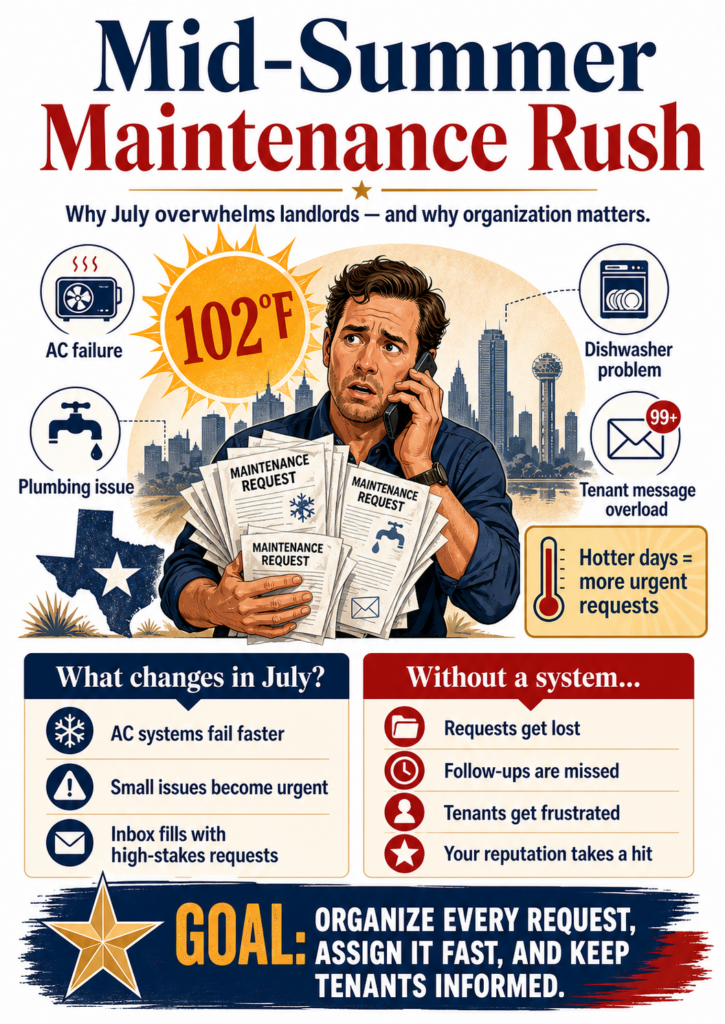
If there’s one thing every Texas landlord knows, it’s that July doesn’t care about your weekend plans. When the temperature hits 102 degrees for the twelfth day in a row, systems that worked perfectly fine in April suddenly decide to give up the ghost.
During the mid-summer rush, your inbox isn’t just full—it’s full of urgent, high-stakes problems. If you don’t have a system for organizing and tracking these maintenance requests, you’ll end up playing a frantic game of whack-a-mole, inevitably forgetting something important until an angry tenant calls to remind you. Let’s talk about how to organize the chaos so you can keep your properties running and your sanity intact.
The Problem with the “Sticky Note” System
When you only have one or two properties, it’s tempting to manage maintenance requests informally. A tenant texts you about a running toilet, you write it on a sticky note, you call your plumber, and you throw the note away when it’s fixed.
But what happens when you have five active requests across three different properties? What happens when the AC goes out at one house, the dishwasher breaks at another, and a third tenant is asking for permission to paint the living room—all on the same Tuesday? The sticky note system collapses. You forget to follow up with the HVAC tech, the tenant sits in a hot house for an extra day, and your reputation as a reliable landlord takes a hit.
Move Everything to a Central Dashboard
The only way to survive the mid-summer maintenance surge is to move every single request onto a centralized digital dashboard. If you use property management software like Buildium or TenantCloud, this is built in. If you don’t, you need to create a dedicated Google Sheet or use a free tool like Trello.
Your dashboard needs to track five critical pieces of information for every request:
1.The property address and tenant name
2.The exact nature of the problem (with photos if possible)
3.The date the request was submitted
4.The assigned vendor
5.The current status (New, Vendor Assigned, Parts Ordered, Complete)
When a tenant texts you a maintenance issue, your immediate response should be to log it on the dashboard. Do not rely on your memory. If it’s not on the board, it doesn’t exist.
The Daily Maintenance Huddle
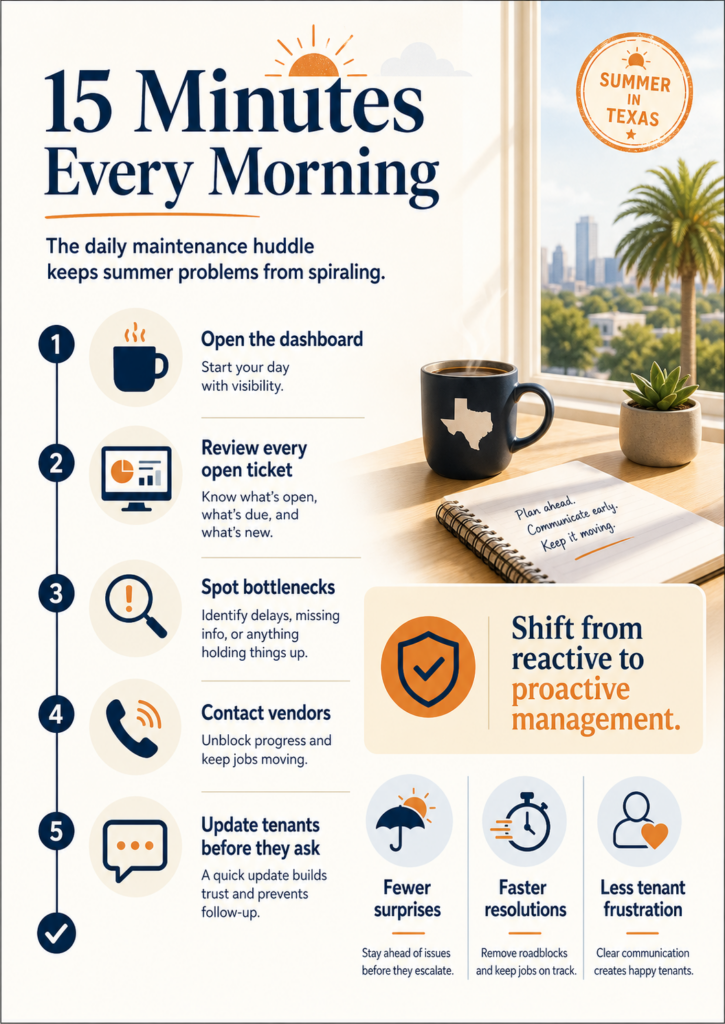
During the peak summer months, I recommend setting aside 15 minutes every single morning for a “maintenance huddle”—even if you’re the only person on your team.
Open your dashboard, grab your coffee, and review every open ticket. This is when you catch the bottlenecks. Did the plumber say he was going out yesterday, but the ticket still isn’t marked complete? Call him. Is the HVAC tech waiting on a part for unit 4B? Text the tenant an update so they know they haven’t been forgotten.
By reviewing the entire board every morning, you shift from reacting to problems as they blow up to proactively managing them before the tenant even has to ask for an update.
Grouping by Geography and Trade
When you’re staring at a board with six open maintenance requests, you have to dispatch your vendors efficiently. This is where grouping comes in.
If you have two properties in the same neighborhood that both need minor plumbing work (a slow drain at one, a running toilet at the other), do not send the plumber out on Tuesday for one and Thursday for the other. Group those tickets together and dispatch the vendor for a single half-day block. You’ll save on trip charges, and your vendor will appreciate the consolidated work.
Similarly, if you have a handyman heading out to fix a fence gate, check your board for any other minor Tier 3 requests at that property. Have him caulk the bathtub and change the hard-to-reach air filter while he’s there.
The Power of the Follow-Up
The final step in organizing a maintenance request is closing the loop. When a vendor tells you a job is done, the ticket isn’t actually complete until you verify it with the tenant.
Send a quick, templated text or email: “Hi Sarah, the plumber let me know the sink is fixed. Just wanted to check in and make sure everything is working perfectly on your end!”
This takes ten seconds, but it accomplishes two things. First, it catches the 10% of jobs where the vendor didn’t actually fix the root cause of the problem. Second, it shows the tenant that you care about the quality of their home, not just the fact that the work order was checked off. That kind of communication is what turns a one-year lease into a five-year resident.
For rental property landlords managing one to a handful of units, the hardest part isn’t big renovations; it’s the nonstop drip of small problems that never wait for a convenient time. Every ignored rattle, stain, or slow leak turns into a bigger bill and a bigger headache, and tenant satisfaction drops fast when repairs feel delayed or dismissed. Rental property maintenance urgency isn’t paranoia; it’s basic investment protection and the clearest signal that the property upkeep importance is real. Stay ahead of wear-and-tear, and tenants stay longer.
Build a Landlord Maintenance Routine That Prevents Repairs
Here’s how to move from stress to systems.
This checklist-style routine helps you spot small issues early, schedule simple prevention tasks, and keep tenants confident you’re on top of the place. You don’t need to be handy, just consistent.
Step 1: Set a repeatable inspection rhythm Start with one monthly walk-through per unit and a quick exterior check, then put it on a calendar you actually use. A simple tool like a 6-monthly inspection checklist keeps you from forgetting the same problem spots every time. Consistency beats intensity because patterns show up fast when you look regularly.
Step 2: Walk the unit in the same order, every time Begin at the entry and move room by room: ceilings, walls, floors, windows, and then fixtures and appliances. Test the easy stuff as you go like running water, flushing toilets, flipping exhaust fans on, and checking under sinks. Doing it the same way builds a habit and makes changes obvious.
Step 3: Document issues and decide “fix now” vs “monitor” Take photos, write a one-line note, and tag each item with a deadline so nothing lives in your head. Treat moisture and mold as urgent, since ICC Property Maintenance Code Section 308 ties maintenance to health and habitability expectations. Clear notes also reduce tenant tension because you can explain what’s happening and when.
Step 4: Batch preventative tasks into a simple monthly to-do Create one short list you can finish in 60 to 90 minutes: replace HVAC filters if applicable, clear dryer vents if you control them, check caulk and grout, tighten loose handles, and look for slow drips. Small tasks like these prevent the common “tiny leak becomes big damage” scenario. If a task requires a pro, schedule it right away while the problem is still small.
Step 5: Add seasonal care so the weather doesn’t ambush you Do a spring and fall pass focused on the building shell: gutters, downspouts, grading, exterior hoses, weatherstripping, and any signs of pests. Plan ahead for heating and cooling strain by booking servicing before the hottest and coldest weeks hit. Seasonal planning keeps emergencies from stacking up at the worst possible time.
Stay steady with this routine, and you’ll feel repairs getting rarer and tenant messages getting calmer.
Use a Warranty Plan to Keep Surprise Repairs Predictable
Even with a solid routine, stuff still breaks at the worst possible time.
That’s where a home warranty can keep your maintenance budget and your tenants’ patience from getting wrecked by surprise failures. Home warranties are customizable annual service plans that help cover the repair or replacement of major home systems and appliances when they conk out from normal wear and tear. Instead of eating the full cost of a sudden HVAC, water heater, or appliance issue, you pay for the plan and use it when covered items fail. Many plans also let you add optional coverage for extra items, so you can tailor protection to the parts of your rental most likely to cause expensive, last-minute headaches.
When you can get covered repairs moving quickly and affordably, it’s a lot easier to meet tenant repair expectations, and the next checklist will help you track it all without dropping the ball.
Rental Maintenance Checklist You Can Actually Follow
Keep this simple and visible:
A tight checklist keeps small problems from turning into tenant complaints, late-night calls, and budget blowups. It also reduces decision fatigue, especially when 61% of property owners say maintenance is their biggest stress point.
✔ Set a monthly walk-through date and stick it on your calendar
✔ Track every repair request with date, photos, and resolution notes
✔ Test smoke and CO alarms and replace batteries on schedule
✔ Inspect leaks under sinks, around toilets, and at the water heater
✔ Clean or replace HVAC filters and confirm vents are unobstructed
✔ Check locks, latches, and window seals for safety and drafts
✔ Review vendor contacts and response times before something breaks
Check these off, and you will look organized even when chaos hits.
Quick answers to prevent confusion before it turns into conflict.
Q: What repairs are the landlord’s responsibility vs. the tenant’s? A: Landlords typically handle habitability and systems: plumbing, heat, hot water, electrical, and weatherproofing. Tenants usually handle day-to-day cleanliness and minor damage they cause. Put the specifics in writing and give real examples so nobody “remembers it differently” later.
Q: How much should I budget for maintenance each year? A: A simple rule is to plan for 1%–4% of the property’s value annually and adjust up for older buildings. Keep a separate repair reserve so one big issue does not wreck cash flow. If the reserve is thin, start with the safety items and water leaks first.
Q: When should I replace something instead of repairing it again? A: Replace when the same item fails twice in a year, parts are hard to source, or the repair cost is close to replacement. Also, replace when downtime upsets tenants, like repeated HVAC problems. Ask vendors for a “repair vs. replace” quote in writing.
Q: How do I get tenants to report issues early without feeling like I’m policing them? A: Make reporting easy: one method, one photo, one short description, and a promised response window. An agreement with your tenants helps them know what to watch for and what is truly urgent. Thank them for fast reporting so it feels rewarded, not punished.
Q: Can I enter to inspect or fix things without upsetting tenants? A: Yes, but do it cleanly: give proper notice, offer two appointment windows, and confirm the exact work you are doing. Keep visits brief, leave the area tidy, and send a quick completion message. Predictable, respectful entry builds trust fast.
Keep the property steady, and tenant satisfaction stops being a gamble.
Lock In a Maintenance Rhythm That Keeps Tenants and Value
Rentals fall apart when maintenance turns into a scramble, missed messages, blurred responsibilities, and fixes that come too late. The answer is proactive rental property care backed by a real landlord maintenance commitment, not vibes: regular property upkeep on a schedule, clear communication, and fast decisions when something breaks. Do that, and the tenant retention benefits show up quickly, fewer complaints, fewer surprises, and fewer vacancies eating your cash flow. Routine upkeep keeps tenants longer and protects your property’s value. Pick a start date today and put the next check-in on the calendar so it actually happens. That’s long-term care that keeps the whole operation stable year after year.
Please subscribe to unlock this content. Enter your email to get access.
An expense is money you spend. An investment is capital you deploy to generate a return. The fundamental distinction between a casual landlord and a serious real estate investor lies in the understanding of that single sentence. A landlord sets rent based on what they think is “fair” or what they charged last year; an investor sets rent based on real-time market data, supply and demand velocity, and a calculated strategy to maximize Net Operating Income (NOI).
Welcome back to Investor Corner, the column dedicated to the business of real estate. We are not here to talk about the color of the year or the latest design fads. We are here to talk about numbers. We are here to analyze how to deploy capital and optimize operations to maximize cash flow, increase NOI, and drive long-term appreciation. And with the peak Texas leasing season upon us, the single most important question an investor can ask is: how do I price my assets right now to capture the greatest possible return?
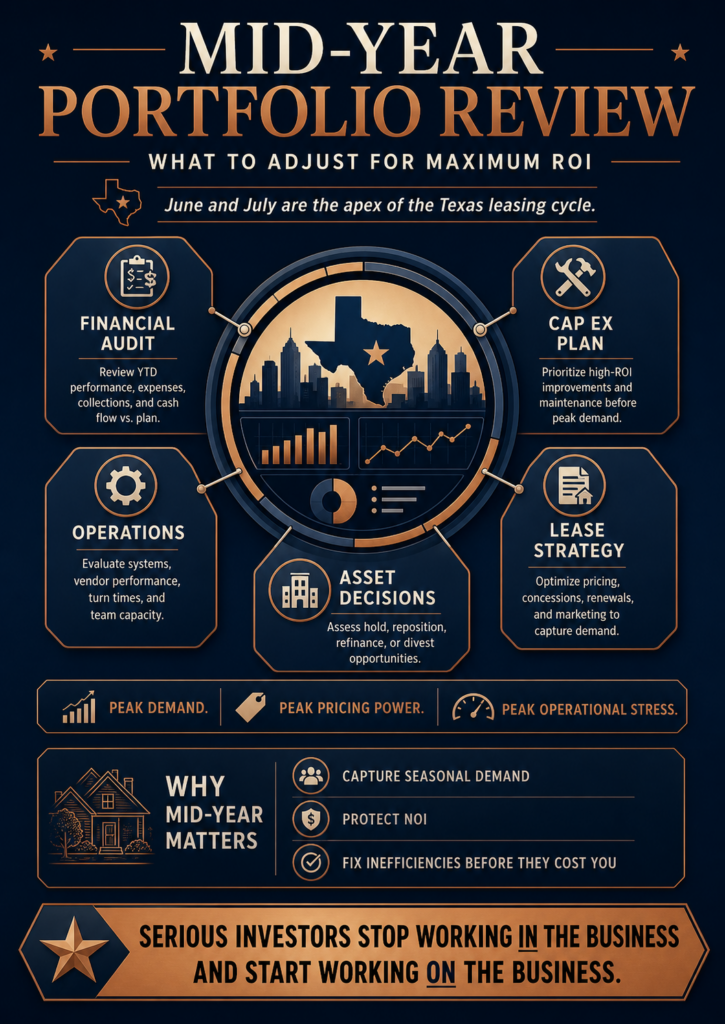
The mid-year point is not merely a date on the calendar; it is a critical operational inflection point. June and July represent the apex of the Texas leasing cycle, a brief window where demand surges, tenant urgency peaks, and pricing power shifts decisively to the property owner. However, this window also coincides with the highest operational stress on your physical assets, particularly HVAC systems and exterior envelopes subjected to triple-digit heat.
A mid-year portfolio review is the disciplined process of evaluating your assets, your numbers, and your operational efficiency to ensure you are positioned to capitalize on this peak season rather than merely survive it. It is the moment when serious investors stop working in their business and start working on their business.
The Financial Audit: Evaluating Your NOI
The foundation of any portfolio review is a ruthless examination of your Net Operating Income. Real estate is a math equation, and mid-year is the time to verify that the equation is still balancing in your favor.
Begin by analyzing your trailing twelve months (TTM) of operating expenses. In the current economic climate, insurance premiums and property taxes in major Texas metros—from the Dallas-Fort Worth sprawl down to the Houston suburbs—have escalated at unprecedented rates. A casual landlord absorbs these increases and hopes for the best; an investor identifies the margin compression and formulates a strategy to offset it.
Review your current rent roll against active market comparables. Are your long-term tenants currently paying 15% below market rate? If so, you are effectively subsidizing their housing costs out of your own equity. While tenant retention is valuable, there is a mathematical limit to the discount you should offer. The mid-year review is the time to identify these disparities and plan targeted rent adjustments to bring your portfolio back into alignment with the market.
The Cap Ex Assessment: Strategic Capital Deployment
Capital expenditures (Cap Ex) are the large, infrequent investments required to maintain or upgrade an asset. The mid-year review is the moment to transition from reactive repairs to proactive capital deployment.
Evaluate the remaining useful life of your major systems. If an HVAC unit in an Austin duplex is 14 years old and has required two service calls this spring, waiting for it to fail in August is not a strategy; it is a liability. An emergency replacement during peak summer demand carries a significant premium in both labor costs and tenant goodwill. By planning that replacement during the mid-year review, you control the timeline, negotiate better pricing, and protect your asset from the cascading damage of a mid-summer failure.
Furthermore, assess the ROI of potential cosmetic upgrades. Not all renovations are created equal. The mid-year review is the time to identify the high-yield, low-cost improvements—such as a fresh coat of modern, neutral paint or upgraded cabinet hardware—that will allow you to push rents to the top of the market tier during the summer turnover window. Remember the formula: Annual Rent Increase / Cost of Upgrade = ROI. If a $2,000 paint job allows you to increase rent by $100 a month, that is a 60% cash-on-cash return, a metric that justifies the capital deployment.
The Operational Stress Test
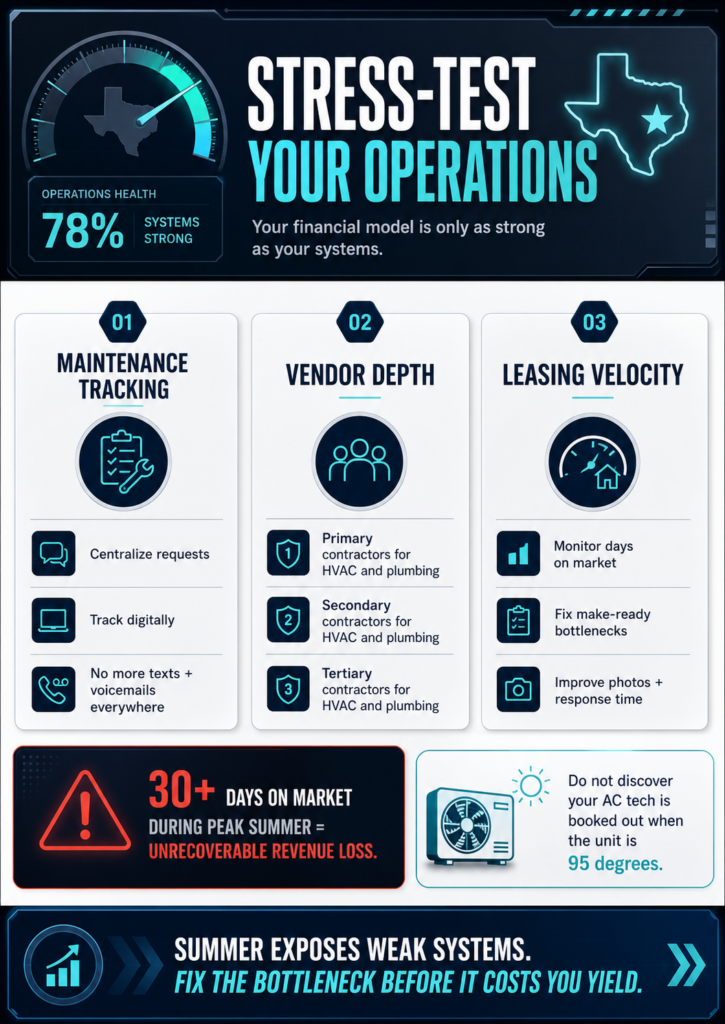
Your financial models are only as strong as the operational systems that support them. The mid-year review must include a critical assessment of your property management efficiency.
Are your maintenance requests centralized and tracked digitally, or are they scattered across text messages and voicemails? The summer surge will expose the fractures in any analog system. Evaluate your vendor roster. Do you have secondary and tertiary contractors for critical trades like plumbing and HVAC? The time to discover that your primary AC technician is booked two weeks out is not when a tenant’s unit is sitting at 95 degrees.
Review your leasing velocity. If your average “days on market” for a vacant unit is exceeding 30 days during the peak summer season, your operational machinery is failing. The bottleneck could be a sluggish make-ready process, poor listing photography, or an unresponsive leasing agent. Identify the friction point and eliminate it. Every day a unit sits vacant is unrecoverable revenue that permanently damages your annual yield.
The Lease Expiration Strategy
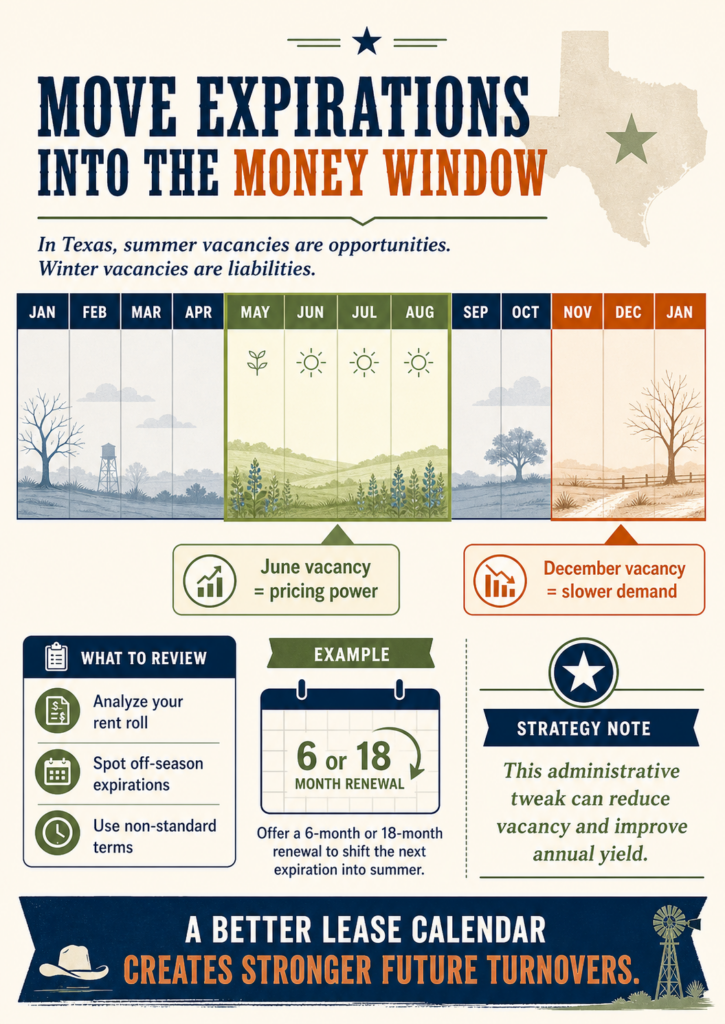
One of the most powerful, yet frequently overlooked, tools in an investor’s arsenal is the strategic manipulation of lease expiration dates. The mid-year review is the perfect time to analyze your rent roll and identify when your current leases are scheduled to terminate.
In Texas, the leasing market is highly seasonal. A vacancy in June is an opportunity; a vacancy in December is a liability. If you have multiple leases expiring between November and January, you are exposing your portfolio to extended vacancy periods and depressed winter rental rates.
Use the mid-year review to correct this trajectory. When negotiating renewals for off-season expirations, offer non-standard lease terms—such as a 6-month or 18-month extension—to force the next expiration date into the lucrative May-to-August window. This simple administrative adjustment ensures that your future turnovers will always occur when you have maximum pricing power.
Evaluating Financing and Debt Structure
Beyond the operational and physical aspects of your properties, the mid-year review is the ideal time to evaluate the capital stack supporting your portfolio. The debt structure you secured three years ago may no longer be the optimal vehicle for your current investment strategy.
Analyze your current interest rates, amortization schedules, and loan-to-value (LTV) ratios. In a fluctuating interest rate environment, opportunities for strategic refinancing can emerge unexpectedly. If your portfolio has experienced significant appreciation—a common occurrence in high-growth Texas markets like Austin and the Dallas-Fort Worth metroplex—you may have substantial trapped equity.
A serious investor evaluates whether that equity is best left dormant or whether it should be extracted via a cash-out refinance or a home equity line of credit (HELOC) to fund further acquisitions. Conversely, if you are holding variable-rate debt in a rising rate environment, the mid-year review is the time to model the impact of those increases on your cash flow and determine if securing fixed-rate financing is a necessary defensive maneuver to protect your NOI.
Assessing Property Management Performance
If you utilize a third-party property management company, the mid-year review must include a rigorous evaluation of their performance. You are paying a premium for their services, and you must verify that they are delivering a corresponding return on that investment.
Request a comprehensive mid-year reporting package. Scrutinize their maintenance response times, their average cost per turnover, and their tenant retention rates. Are they consistently securing market-rate renewals, or are they accepting flat renewals to minimize their own administrative workload?
Furthermore, evaluate their communication and transparency. A property manager is the steward of your multi-million dollar asset; if you are constantly chasing them for updates or discovering deferred maintenance during your own inspections, they are failing in their fiduciary duty. The mid-year review is the moment to have the difficult conversations, establish clear performance KPIs for the remainder of the year, or make the calculated decision to transition to a new management partner before the peak season concludes.
The Long-Term Hold vs. Divestiture Analysis
Finally, the most profound question an investor must ask during a mid-year review is whether a specific asset still aligns with their long-term investment thesis. Not every property is meant to be held indefinitely.
Analyze the Return on Equity (ROE) for each property in your portfolio. A property that generates strong cash flow but holds massive, trapped equity may actually be underperforming when measured by ROE. If a property in a rapidly appreciating Austin neighborhood has doubled in value, the cash flow it generates relative to that new equity baseline might be significantly lower than what you could achieve by executing a 1031 exchange and deploying that capital into a larger multi-family asset in an emerging market.
Conversely, identify the “headache” properties—the assets that consistently consume a disproportionate amount of your operational bandwidth and capital reserves. If a property is located in a declining submarket, suffers from chronic structural issues, or consistently attracts problematic tenant profiles, the mid-year review is the time to make the unemotional, mathematical decision to divest. Liquidating an underperforming asset and reallocating that capital is not a failure; it is the essence of active portfolio management.
The Value of the Mid-Year Pivot
The real estate market does not pause to accommodate inefficiency. It rewards preparation, penalizes complacency, and relentlessly exposes operational weaknesses.
The mid-year portfolio review is not a mere administrative exercise; it is the strategic pivot that separates the passive property owner from the active investor. It is the deliberate process of analyzing the data, identifying the vulnerabilities, and deploying the necessary capital and operational adjustments to maximize your return on investment.
As we enter the peak of the Texas leasing season, the question is not whether the market will present opportunities. The question is whether your portfolio is optimized to capture them. Grab your spreadsheets, analyze your rent rolls, and execute the adjustments required to drive your NOI forward. In the business of real estate, the math never lies, and the prepared investor always wins.