This Content Is Only For Subscribers
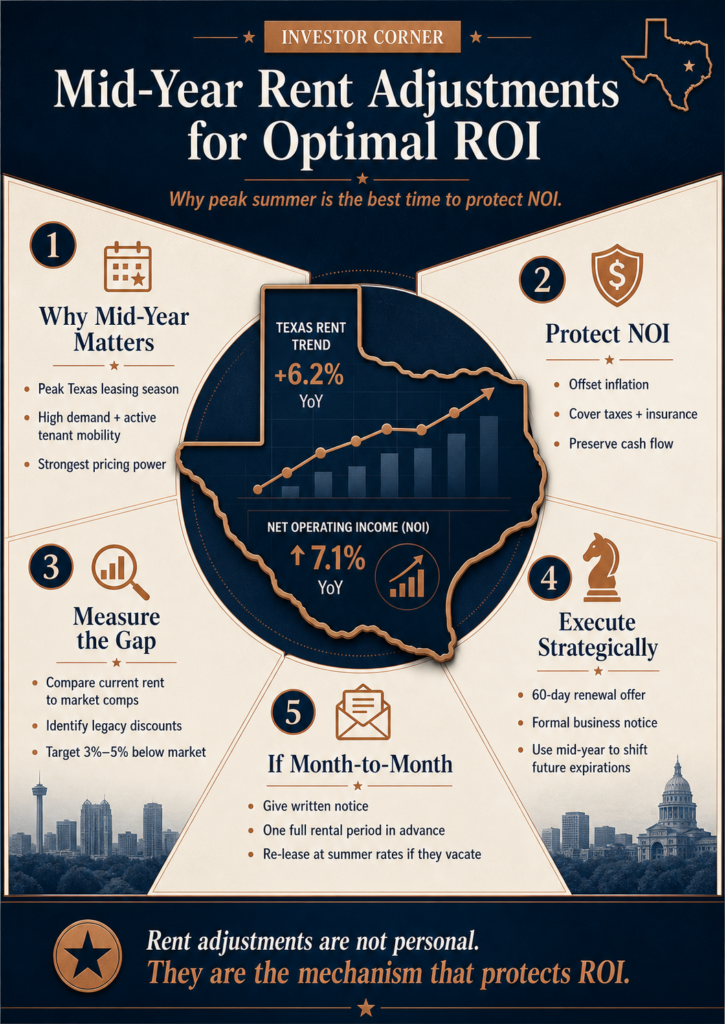
There is a prevailing sentiment among casual landlords that raising rent on a good tenant is bad business. They prioritize harmony over yield, allowing their rents to stagnate while their operating expenses climb. A serious investor views rent adjustments through a different lens: it is the necessary, mathematical mechanism required to maintain the asset’s Net Operating Income (NOI) in the face of inflation, rising property taxes, and escalating insurance premiums.
The mid-year point—the absolute peak of the Texas leasing season—is the optimal window to execute these adjustments. Demand is high, tenant mobility is active, and your pricing power is at its zenith.
The Cost of the “Nice Landlord” Discount
Tenant retention has undeniable financial value. A turnover costs money—typically one month’s rent in vacancy, plus make-ready expenses and leasing fees. However, there is a mathematical ceiling to the value of that retention.
If market rent for your Dallas duplex is $2,400, but you are charging a legacy tenant $2,000 because they pay on time and never complain, you are providing a $4,800 annual subsidy. Over three years, that is nearly $15,000 in lost revenue. Furthermore, because commercial and multi-family valuations are driven by NOI, that $4,800 annual shortfall, at a 6% cap rate, represents an $80,000 reduction in the underlying value of the asset.
The mid-year review is the time to quantify the “Nice Landlord” discount across your portfolio. Your goal is not to drive good tenants out; your goal is to close the gap between actual rent and market rent to a mathematically defensible margin—typically 3% to 5% below market.
The Mid-Year Market Analysis
You cannot adjust rent strategically without accurate data. Consumer-facing algorithms like Zillow’s Zestimate are blunt instruments that often lag behind real-time market velocity. To determine the true market ceiling during the summer peak, you must conduct a hyper-local comparable analysis.
Look at active listings within a one-mile radius of your property. Filter strictly for similar square footage, bedroom counts, and finish levels. The most critical metric in this analysis is “Days on Market” (DOM). If comparable properties are leasing at $2,200 in under five days, the market is signaling that the ceiling is actually higher. If they are sitting for 45 days at $2,400, you have found the resistance point.
In the Texas summer market, driven by school-calendar relocations and corporate transfers, tenants are operating with urgency. This compressed timeline creates a temporary pricing premium. Your mid-year rent adjustments should capture this premium.
Structuring the Renewal Offer
When presenting a mid-year rent adjustment to an existing tenant, professionalism and structure are your best tools for minimizing friction. The communication should not be an apology; it should be a formal business notification.
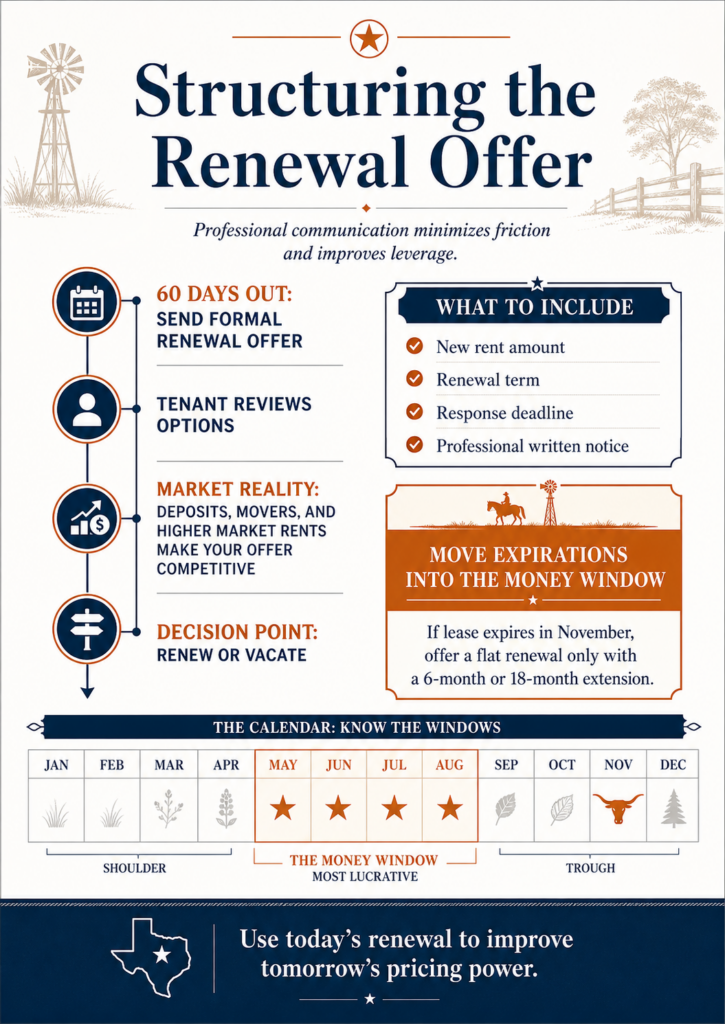
Provide the renewal offer 60 days prior to lease expiration. This complies with standard Texas Association of Realtors (TAR) lease requirements and gives the tenant ample time to test the market. When they realize that moving will cost them thousands of dollars in deposits, moving trucks, and the new, higher market-rate rent, your adjusted renewal offer suddenly appears highly competitive.
Furthermore, use the mid-year renewal to strategically manipulate future expiration dates. If you have a tenant whose lease expires in November—the absolute trough of the Texas leasing cycle—offer them a flat renewal only if they sign a 6-month or 18-month extension. This forces their next expiration into the lucrative May-to-August window, permanently improving your future pricing leverage.
Executing the Month-to-Month Increase
For tenants currently operating on a month-to-month basis, the mid-year adjustment is even more critical. Under Texas Property Code Section 91.001, a landlord can alter the terms of a month-to-month tenancy, including the rent amount, by providing written notice at least one full rental period in advance.
Do not allow month-to-month tenants to ride out the peak summer season at winter rates. Issue the formal 30-day notice of rent increase now. If they choose to vacate, they are doing so during the exact window when you can re-lease the property at the absolute top of the market.
The Bottom Line
Rent adjustments are not personal; they are the fundamental mechanism of real estate investing. By utilizing the mid-year peak season to aggressively close the gap between your current rent roll and active market comparables, you protect your NOI, offset rising Texas operating expenses, and force massive appreciation into your portfolio.