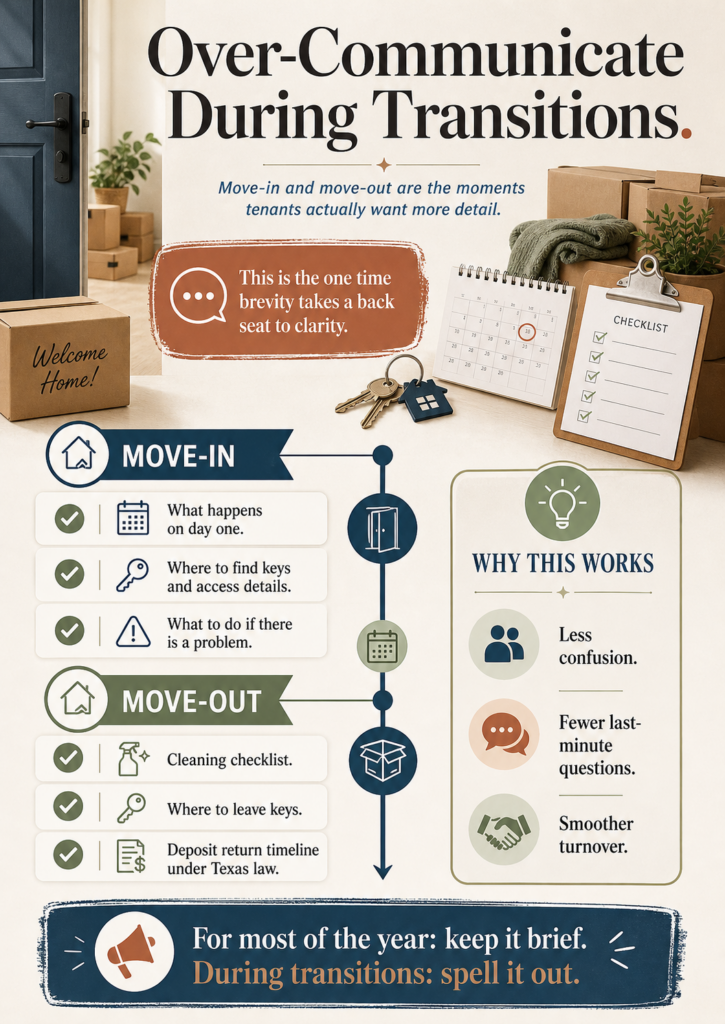
This Content Is Only For Subscribers
The Texas summer rental market is characterized by velocity. High demand, rapid turnover, and compressed timelines create an environment where operational efficiency is paramount. However, this same velocity is the primary catalyst for legal disputes. When property managers and landlords prioritize speed over strict adherence to protocol, they inadvertently lay the groundwork for conflicts that surface months later in eviction courts or mediation.
The most effective strategy for avoiding legal disputes during peak season is not simply hiring better legal counsel; it is building a defensible operational framework that prevents disputes from materializing in the first place.
The Danger of Verbal Agreements
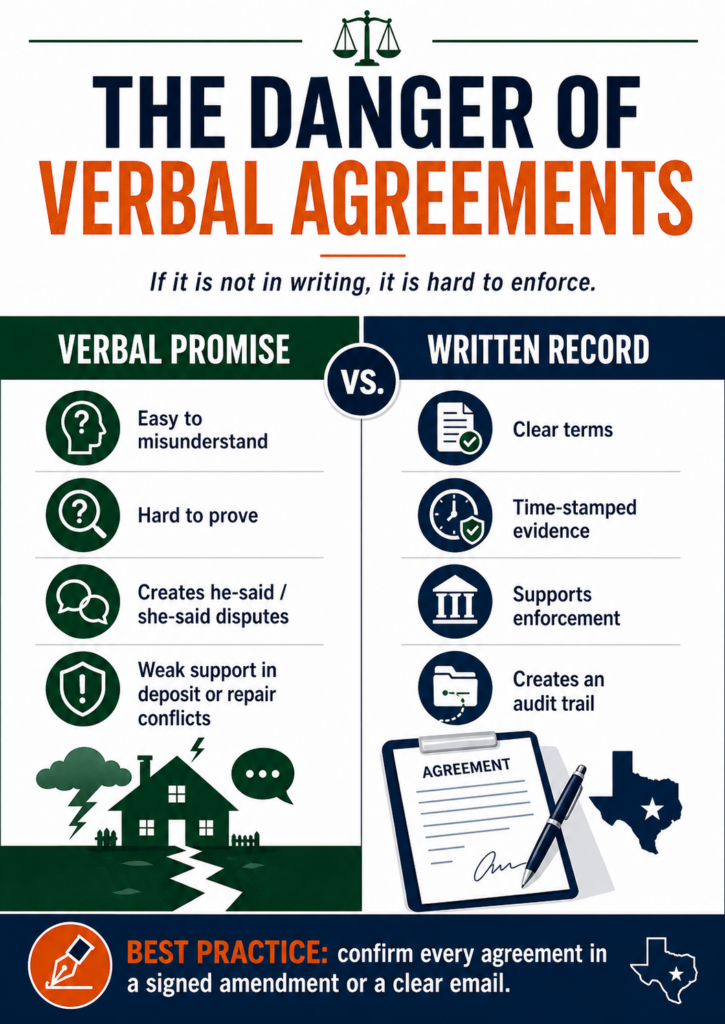
The single greatest source of legal vulnerability during the summer rush is the casual verbal agreement. In the haste of a move-in walkthrough or a frantic phone call regarding a delayed contractor, it is tempting to make informal promises: “Don’t worry about the scuff on the wall, I won’t charge you for it,” or “I’ll have the dishwasher fixed by Friday.”
These informal assurances are legally perilous. The standard Texas Association of Realtors (TAR) lease, which governs the vast majority of residential tenancies in the state, contains an “Entire Agreement” clause. This clause explicitly states that the written lease constitutes the entire agreement between the parties and that any prior or contemporaneous oral agreements are superseded.
In a legal dispute, a verbal promise is essentially a “he said, she said” scenario, which rarely favors the landlord in a contested security deposit deduction or a claim of delayed repairs. The rule must be absolute: if it is not in writing, it does not exist. Every agreement, waiver, or promise made during the peak season must be documented in a formal lease amendment or, at minimum, a time-stamped email acknowledging the specific terms discussed.
Establishing a Formal Communication Protocol
The proliferation of text messaging has severely degraded the formal communication protocol between landlords and tenants. While text messaging is convenient for coordinating a plumber’s arrival time, it is a legally insufficient medium for official notices, lease modifications, or documenting repair requests.
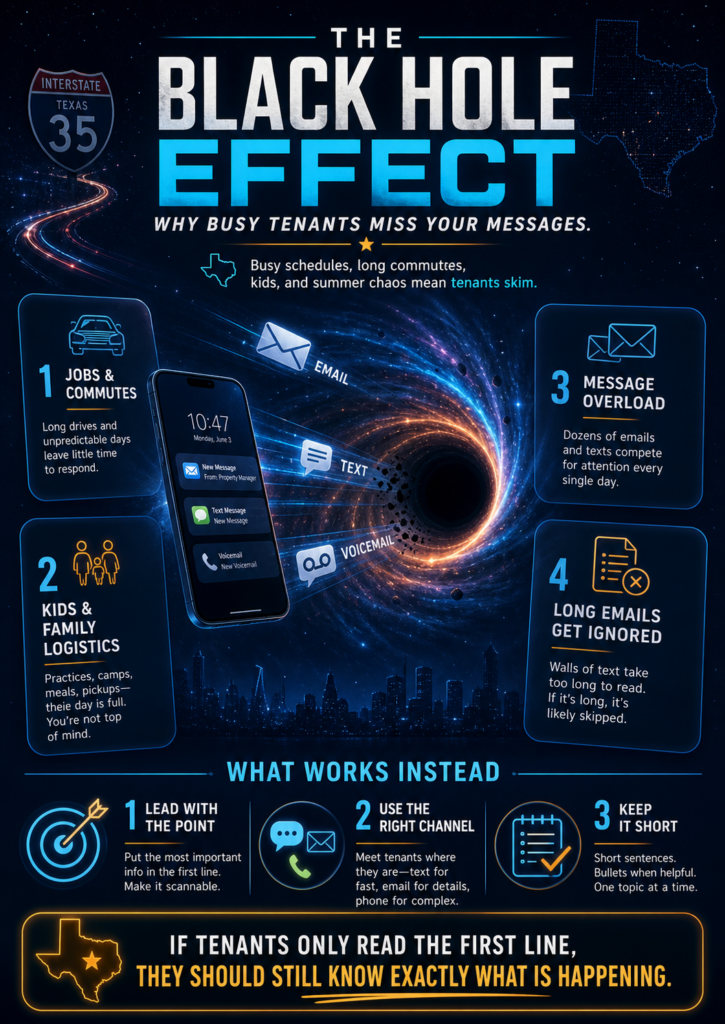
During peak season, the volume of communication spikes, making it easy for critical information to be lost in a fragmented text thread. To avoid disputes, landlords must establish and enforce a centralized, formal communication channel. This is best achieved through a dedicated property management portal where tenants submit formal, time-stamped maintenance requests and where the landlord issues official notices.
If a portal is not feasible, email must be the designated channel for all substantive communication. By funneling all requests and notices through a searchable, documented medium, the landlord creates an unassailable audit trail. When a tenant claims they reported a leaking roof three weeks ago, the portal or email archive provides definitive proof of the timeline, protecting the landlord from claims of negligence under the Texas Property Code’s duty to repair statutes.
The Move-In Walkthrough as a Legal Baseline
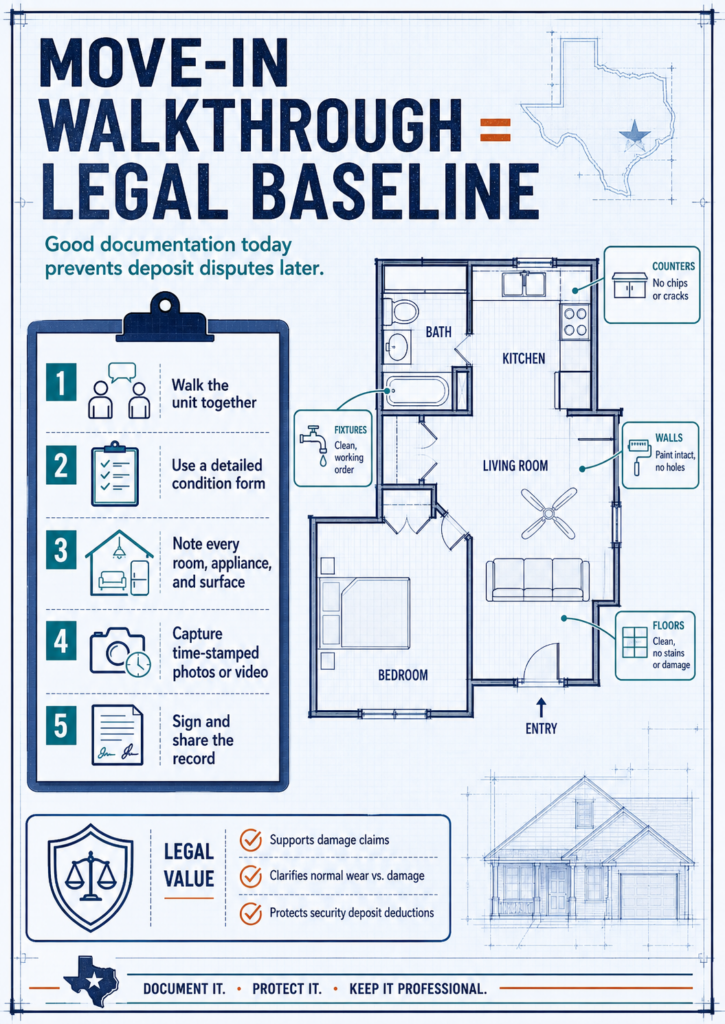
The majority of security deposit disputes originate not at move-out, but at move-in. During the summer rush, it is common practice to simply hand the new tenant the keys and a blank condition inventory form, trusting them to complete it accurately. This is a critical error.
The move-in condition form is not a logistical chore; it is the evidentiary baseline upon which all future damage claims will be judged. If the form is incomplete, vague, or missing entirely, the landlord forfeits their ability to prove that damage occurred during the tenancy. Under Texas law, the landlord bears the burden of proving that damage exceeds “normal wear and tear.” Without a comprehensive move-in baseline, that burden is nearly impossible to meet.
To avoid disputes, the landlord or property manager must conduct a joint walkthrough with the tenant. The condition form must be granular, noting the specific condition of every room, appliance, and surface. Crucially, this written documentation must be supplemented with comprehensive, time-stamped photographic or video evidence. A shared, signed, and photographed baseline eliminates ambiguity and provides the definitive evidence required to justify deductions at the end of the lease term.
Proactive Conflict Resolution
The ultimate defense against legal disputes is proactive communication. When the summer rush causes inevitable delays—a contractor is backlogged, or a part for the HVAC system is on backorder—silence is the enemy. Tenants who feel ignored are the ones who seek legal recourse or withhold rent (a practice generally prohibited in Texas, but nonetheless common).
By communicating delays promptly, professionally, and in writing, landlords de-escalate tension and demonstrate a good-faith effort to resolve the issue, which is a critical defense in any habitability claim. In the high-velocity Texas summer market, strict documentation and proactive communication are the twin pillars of a legally secure portfolio.