This Content Is Only For Subscribers
Self-management is the most popular cost-cutting strategy among small landlords. The logic is straightforward: why pay a property manager 8% to 10% of monthly rent when you can handle the calls, coordinate the repairs, and collect the checks yourself? On a $2,000-a-month rental, that fee represents $160 to $200 every month, or roughly $1,920 to $2,400 per year. Keeping that money feels like an obvious financial win.
The problem is that self-management is not free. It carries a real cost that never appears on a bank statement, never shows up in a profit and loss report, and is almost never factored into the cash flow calculations landlords use to evaluate their investments. That cost is time, and in the business of real estate, time has a measurable dollar value.

The Time Ledger Most Landlords Never Build
An honest accounting of self-management requires tracking every hour spent on property-related tasks over the course of a year. Most landlords significantly underestimate this number because they think only of the large, visible tasks: showing a vacant unit, signing a lease, or overseeing a major repair. They forget the accumulated weight of the smaller tasks that fill the gaps between those events.
Consider a typical month for a landlord managing two single-family rentals in the Dallas-Fort Worth area. Responding to a maintenance request, coordinating with a plumber, and following up on the repair takes forty-five minutes. Reviewing a rental application and checking references takes an hour. Driving to a property to assess a reported issue takes forty-five minutes round trip.
Logging expenses and reconciling rent payments takes an hour at month end. None of these tasks feel significant in isolation. Together, they can easily consume eight to twelve hours per month.
At twelve hours per month, a landlord managing two properties is investing 144 hours per year in management tasks. If that landlord values their time at $50 per hour, a conservative figure for a professional with meaningful alternatives, the true annual cost of self-management is $7,200. That is not money saved by avoiding a property manager. That is money spent in the form of time, whether it is recognized or not.
The Expertise Gap and Its Financial Consequences
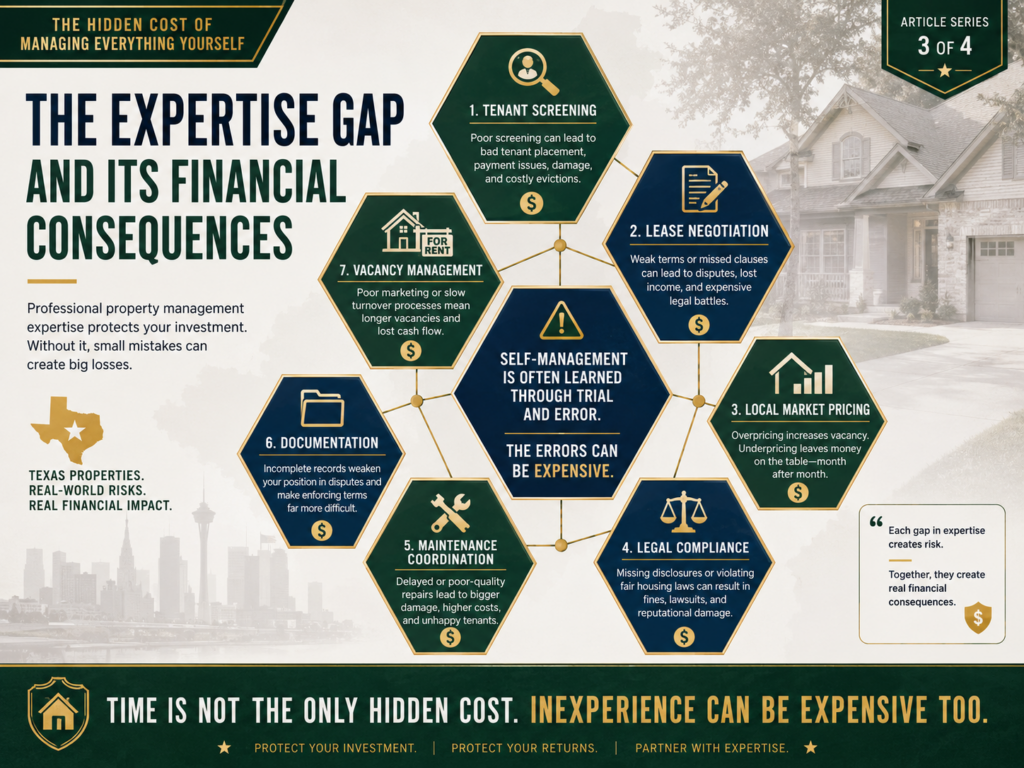
Time is not the only hidden cost. There is also the expertise gap. A professional property manager brings years of experience in tenant screening, lease negotiation, local market pricing, and legal compliance. A self-managing landlord acquires that expertise through trial and error, and the errors can be expensive.
A poorly screened tenant who pays late, damages the property, and requires an eviction can cost a Texas landlord between $3,000 and $7,000 in lost rent, legal fees, and make-ready expenses. A lease missing the proper disclosures required under the Texas Property Code can expose the landlord to liability. A rent price set 10% below market because the landlord skipped the comparable research costs $2,400 per year on a $2,000-a-month property. These are not hypothetical risks. They are the predictable consequences of operating without the professional knowledge a qualified property manager carries as a baseline.
When the Math Actually Favors Self-Management
Self-management is not always the wrong choice. For a landlord with genuine flexibility in their schedule, a strong network of reliable contractors, and a thorough understanding of Texas landlord-tenant law, managing one or two properties personally can be a rational decision. The key is making that decision with accurate information rather than the false assumption that self-management is free.
The calculation should be explicit. Estimate the annual hours required to manage the property honestly, assign a dollar value to those hours, and compare the result to the annual cost of professional management. If the property manager’s fee is $2,400 per year and your honest time valuation is $7,200, the math favors delegation. If your time is genuinely unconstrained and the management tasks fit naturally into your schedule without displacing higher-value activities, the math may favor self-management.
The Scalability Problem
The hidden cost of self-management compounds as a portfolio grows. Managing one property personally is manageable. Managing three requires a part-time commitment. Managing five begins to resemble a second job. At some point, the time consumed by management tasks actively prevents the landlord from pursuing the acquisition activity required to grow the portfolio. The cost of self-management is no longer just the value of the hours spent; it is the value of the deals not evaluated, the properties not acquired, and the wealth not built because the landlord was too busy coordinating plumbers and chasing rent payments to focus on the strategic work of investing.
The most successful small portfolio investors in Texas are not the ones who manage everything themselves. They are the ones who understand the true cost of their time and deploy it where it generates the highest return.