This Content Is Only For Subscribers
An expense is money you spend. An investment is capital you deploy to generate a return. The fundamental distinction between a casual landlord and a serious real estate investor lies in the understanding of that single sentence. A landlord collects rent, pays the mortgage, and hopes there is money left over at the end of the month. An investor maps every dollar, understands exactly where the cash flows, and aggressively plugs the leaks that erode Net Operating Income (NOI).
Welcome back to Investor Corner, the column dedicated to the business of real estate. We are not here to talk about the color of the year or the latest design fads. We are here to talk about numbers. We are here to analyze how to deploy capital and optimize operations to maximize cash flow, increase NOI, and drive long-term appreciation. Today, we are dismantling the illusion that tenant communication is a soft skill and examining it for what it truly is: a hard financial metric that directly impacts your bottom line. The single most important question an investor can ask is: how much is poor communication actually costing me?
The Financial Reality of Turnover
The most expensive line item on any real estate ledger is vacancy. When a property sits empty, the financial machinery grinds to a halt. The mortgage, property taxes, and insurance premiums in major Texas markets continue to accrue, but the top-line revenue drops to zero. A casual landlord views tenant turnover as an inevitable cost of doing business; an investor views it as a critical vulnerability that must be aggressively managed.
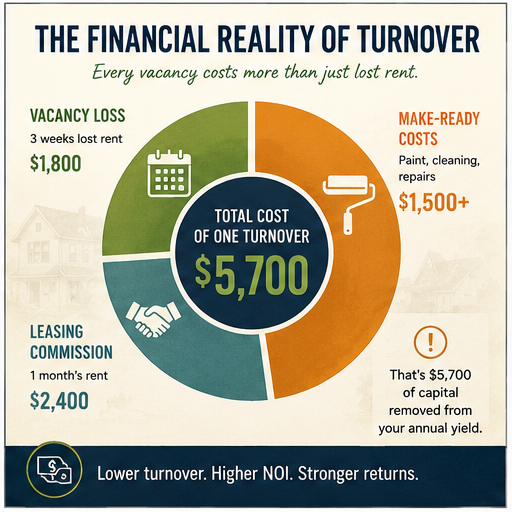
Consider a standard single-family rental in the Dallas-Fort Worth metroplex generating $2,400 a month in gross rent. When a tenant moves out, the financial damage is not limited to the lost rent during the vacancy period. The investor must absorb the cost of the make-ready process—paint, carpet cleaning, minor repairs—which can easily exceed $1,500. They must pay leasing commissions, often equivalent to one month’s rent, to secure a new qualified tenant. Add a conservative three-week vacancy period, and a single turnover event can instantly consume $5,700 of capital.
That $5,700 is not a theoretical number; it is cash that is permanently removed from your annual yield. If your strategy relies on the illusion of gross rent, a single turnover can obliterate your profit margin for the entire year. To transition from a landlord to an investor, you must identify the root causes of turnover and eliminate them. And the data is unequivocal: the primary driver of preventable turnover is not price, but poor communication.
The Cost of the Silent Landlord
Tenants do not generally move because the rent increased by fifty dollars. They move because they feel ignored, disrespected, or structurally insecure in their housing. The silent landlord—the owner who is unreachable when the HVAC fails in a Texas August, or who takes three days to respond to a simple inquiry—creates an environment of structural insecurity.
When a tenant submits a maintenance request for a leaking roof and hears nothing for forty-eight hours, they are not just frustrated by the water damage. They are actively calculating the cost of moving. They are browsing rental listings on Zillow. They are mentally disengaging from the property. By the time the silent landlord finally dispatches a vendor, the damage to the relationship is already done. The tenant has decided that the property is not a stable home, and they will not renew their lease.
The investor tracks this dynamic meticulously. If a property in Houston experiences turnover every twelve months, the cash flow map highlights a systemic issue that requires an operational intervention. The investor audits their communication response times. They implement a rigid 24-hour acknowledgment rule for all inquiries. They understand that a quick, professional response is not a courtesy; it is a retention strategy designed to protect a $5,700 investment.
Communication as Preventive Maintenance
While fixed expenses like taxes and insurance are predictable, variable operating expenses are the silent profit killers that destroy cash flow. These are the day-to-day maintenance costs and the minor repairs that constantly erode NOI.
A leaking faucet, a jammed garbage disposal, or a malfunctioning garage door opener are all variable expenses. The amateur landlord views these as isolated annoyances and often discourages tenants from reporting them, hoping to save money in the short term. The investor takes the exact opposite approach. They actively encourage communication and treat tenant reports as early warning systems.
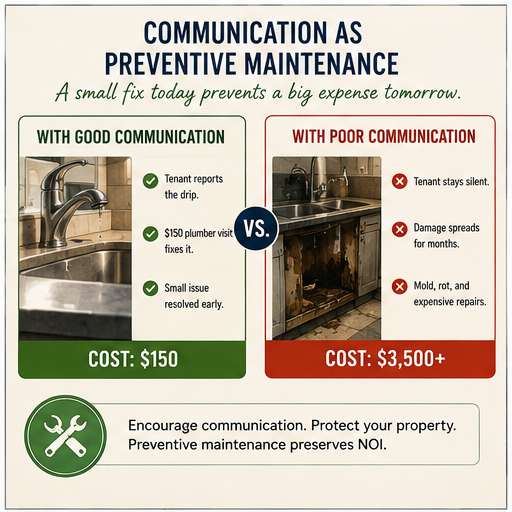
If a tenant notices a slow drip under the kitchen sink and feels comfortable communicating with the landlord, a $150 plumber visit resolves the issue. If the tenant feels that the landlord is hostile, unresponsive, or likely to blame them for the issue, they will put a bucket under the sink and say nothing. Six months later, the slow drip has rotted the cabinet base, compromised the subfloor, and created a mold issue. The $150 preventive maintenance call has metastasized into a $3,500 capital expenditure.
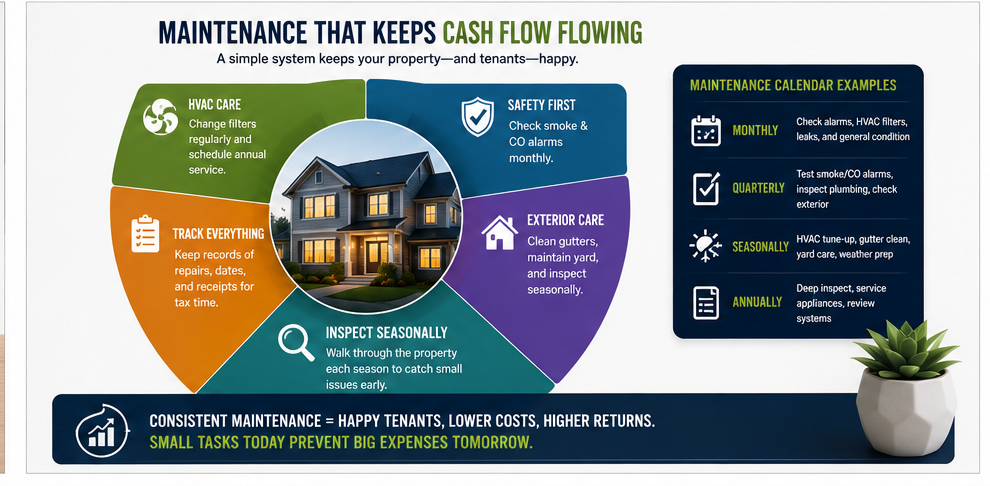
Effective communication is the cheapest form of preventive maintenance available to an investor. By establishing a professional, responsive dialogue, you train your tenants to protect your asset. You transform them from passive occupants into active partners in the preservation of the property.
The Leverage of Clear Expectations
A precise cash flow map accounts for every variable, but operational efficiency requires clear boundaries. The goal of improving tenant communication is not to become a 24/7 concierge service. It is to establish clear, professional expectations that reduce friction and eliminate the endless back-and-forth that consumes your administrative bandwidth.
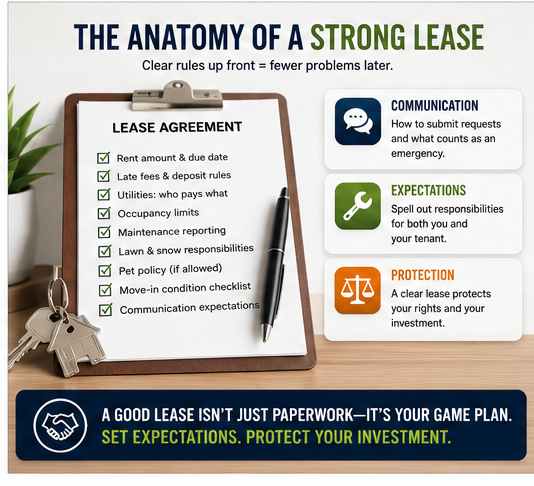
When a lease is signed, the investor does not simply hand over the keys and hope for the best. They execute a structured onboarding process. They provide a clear, written manual detailing exactly how to submit a maintenance request, what constitutes an emergency, and what the standard response times will be. They establish office hours and stick to them.
This clarity is a form of operational leverage. When a tenant knows exactly how the system works, they do not send panicked text messages at midnight for a running toilet. They follow the established procedure. The investor spends less time managing chaotic communication and more time analyzing their portfolio, evaluating debt structures, and identifying new acquisition opportunities. Clear expectations buy back your time, and in the business of real estate, time is the ultimate currency.
The Premium of Reputation
Once operating expenses, vacancy, and Cap Ex have been mapped and subtracted from gross rent, you arrive at Net Operating Income (NOI). This is the true measure of the property’s operational performance. However, NOI can be aggressively expanded by commanding top-of-market rents, and top-of-market rents are inextricably linked to your reputation as an operator.
In a competitive leasing market, prospective tenants are increasingly sophisticated. They read online reviews, they ask outgoing tenants about their experience, and they evaluate the professionalism of the landlord during the showing process. A landlord with a reputation for poor communication, deferred maintenance, and hostility will struggle to attract highly qualified applicants. They will suffer longer vacancy periods and will inevitably have to lower their asking rent to secure a tenant.
An investor with a reputation for operational excellence commands a premium. When a highly qualified applicant—someone with excellent credit, stable income, and a history of treating properties well—evaluates a rental, they are willing to pay slightly more for the assurance of a professional, responsive management experience. This premium drops straight to the bottom line, permanently elevating the NOI of the asset.
The True ROI of the Tenant Experience
For many small landlords, executing a communication audit for the first time is a sobering experience. The realization that their own operational friction is actively driving away good tenants and increasing turnover costs is difficult to accept. This realization is not a failure; it is the beginning of actual investing.
Once you understand the financial value of the tenant experience, you can begin to optimize it. You can deploy automated reminders for seasonal maintenance to protect the asset. You can implement a structured portal system to centralize requests and guarantee rapid response times. You can follow up after every repair to ensure the issue was fully resolved. Every adjustment you make to your communication strategy directly increases your tenant retention rate, and every retained tenant represents thousands of dollars in preserved capital.
The Strategic Pivot
Building a professional communication infrastructure is not a mere administrative exercise; it is the strategic pivot that separates the passive property owner from the active investor. It is the deliberate process of analyzing the data, identifying the vulnerabilities in your tenant retention, and deploying the necessary operational adjustments to maximize your return on investment.
As you evaluate your portfolio, the question is not whether your properties are generating rent. The question is whether your operational machinery is designed to keep that rent flowing year after year without the massive interruption of preventable turnover. Grab your spreadsheets, audit your vacancy costs, and evaluate your communication protocols. In the business of real estate, the math never lies, and the prepared investor always wins.

The Hidden Cost of Misaligned Incentives
The final dimension of tenant communication involves aligning incentives. A serious investor does not view the landlord-tenant dynamic as an adversarial relationship; they view it as a mutual business arrangement where both parties benefit from stability. When communication breaks down, incentives become misaligned, and the property suffers.
Consider the security deposit. A casual landlord often uses the security deposit as a weapon, threatening deductions for minor infractions and creating a hostile environment as the lease end approaches. This approach virtually guarantees that the tenant will stop caring for the property during their final weeks. They have already assumed the deposit is lost, so their incentive to clean or leave the property in good condition evaporates entirely.
An investor takes a radically different approach. They communicate clearly about the security deposit process from day one. Sixty days before move-out, they send a detailed checklist outlining exactly what is required to receive a full refund. They offer a pre-move-out walkthrough to identify potential issues while the tenant still has time to correct them. This strategy aligns the tenant’s financial incentive with the investor’s operational goal of minimizing make-ready costs.
When you communicate clearly and fairly, you do not just protect your cash flow; you actively enlist the tenant in preserving it. The profit you fight to generate on the operational side should not be surrendered unnecessarily to the friction of poor communication.