This Content Is Only For Subscribers
In property management, scale changes everything. The corporate apartment complex down the street has a full time maintenance staff, a digital ticketing system, and a warehouse full of spare parts. If an air conditioning unit fails, they swap it out before lunch. But for the independent landlord managing three single family homes across town, a failed compressor on a Friday afternoon is a crisis. You do not have a warehouse. You have a pickup truck, a limited budget, and a day job.
Welcome to Maintenance Matters. This column is built specifically for the independent operator. We focus entirely on practical, actionable strategies that protect your physical asset without requiring a massive corporate budget or a full time staff. Today, we are building a comprehensive preventive maintenance system specifically designed for the landlord with a small portfolio. The ultimate goal of this system is not to eliminate repairs entirely, which is an impossible standard, but to completely eliminate the catastrophic financial surprises that derail your annual returns.
The Reality of the Small Portfolio
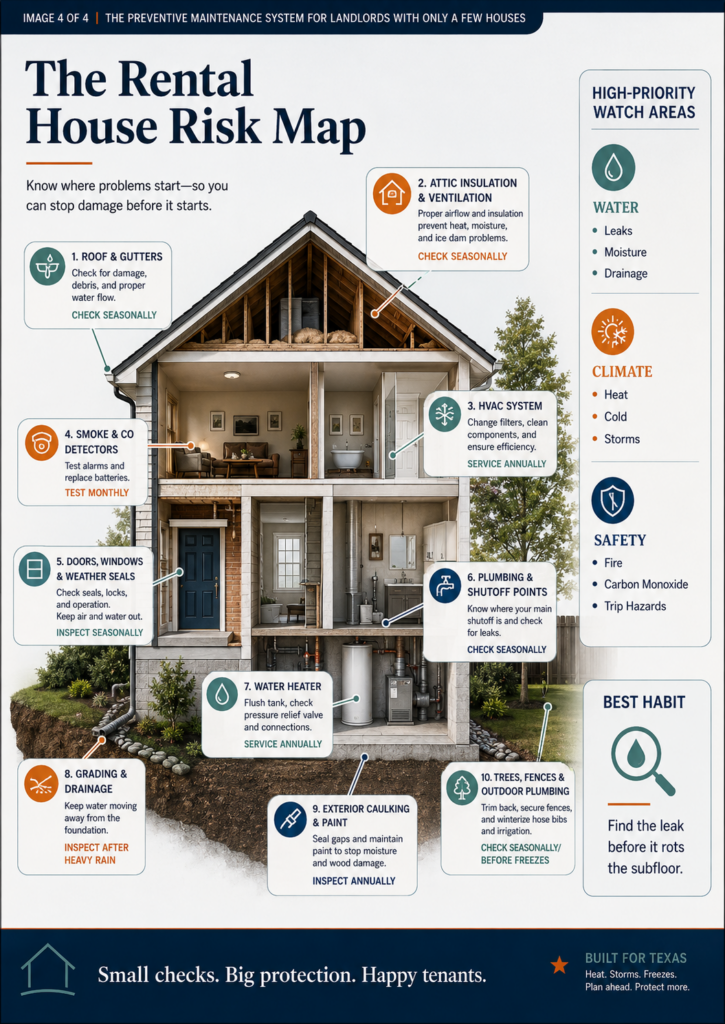
When you only own a few rental properties, your risk is highly concentrated. A ten thousand dollar foundation repair on one house can wipe out your entire profit margin for the year across your entire portfolio. You cannot absorb losses through volume. Therefore, your maintenance strategy must be far more aggressive than the corporate standard. You must find the leak before it rots the subfloor.
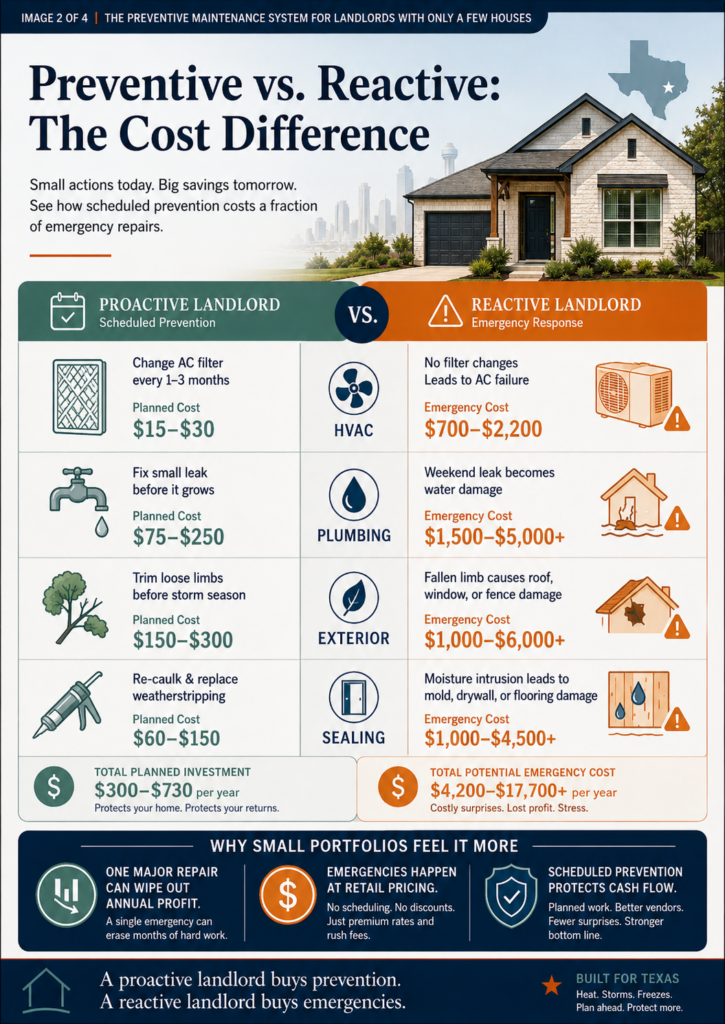
“When I bought my first duplex in Fort Worth, I honestly thought being a good landlord just meant fixing things fast when they broke,” says Mark T., an independent Texas investor who now successfully manages six properties. “I thought speed was the only metric that mattered. It took a flooded kitchen and a four thousand dollar remediation bill to teach me that being a good landlord actually means fixing things before they break. A reactive landlord pays the absolute highest retail price for weekend emergencies. A proactive landlord pays wholesale for scheduled prevention.”
Mark is exactly right. The foundation of a small portfolio strategy is shifting your mindset from emergency response to scheduled prevention.
Building the Annual Maintenance Calendar
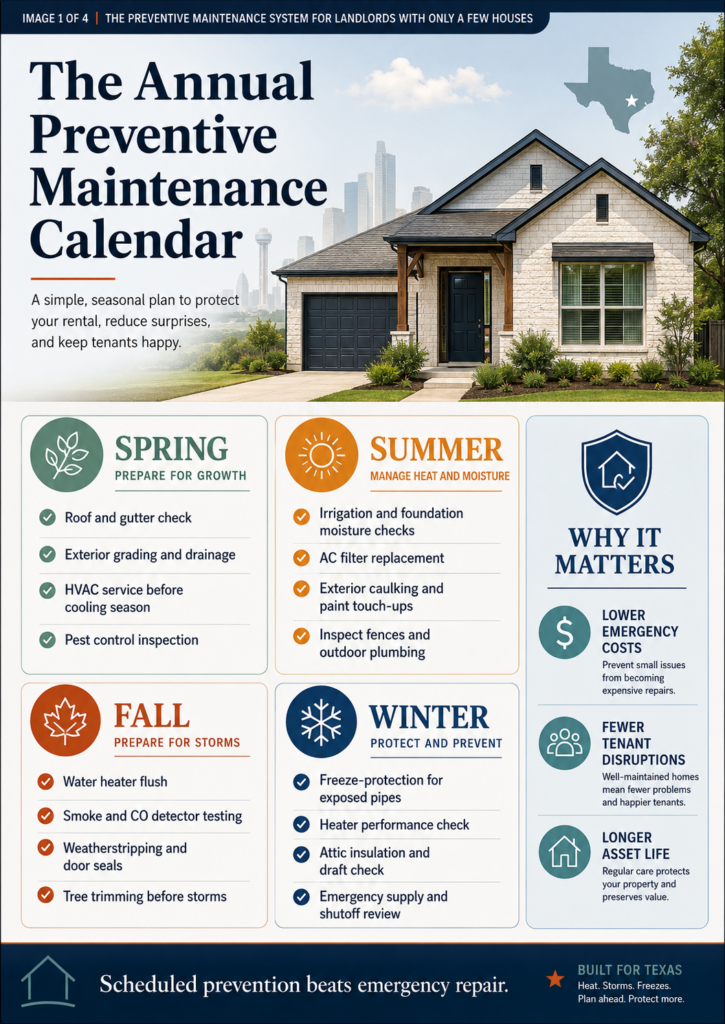
A preventive maintenance system is not a vague intention to check on things occasionally. It is a rigid, scheduled calendar. You must break the year down into seasonal tasks that address the specific threats posed by the Texas climate.
The Spring Preparation Phase
Spring in Texas is the calm before the storm. This is your critical window of opportunity to prepare the physical property for the brutal, unrelenting heat to come. Your absolute primary focus in March and April must be the HVAC system. You must schedule a professional tune up for every single air conditioning unit in your portfolio before the first heat wave hits. The technician should check the refrigerant levels, thoroughly clean the outdoor condenser coils, and flush the indoor condensate drain line to prevent backups. Paying eighty or a hundred dollars for a scheduled tune up in April is infinitely better than paying two thousand dollars for an emergency compressor replacement on a holiday weekend in July.
Spring is also the time to inspect the exterior building envelope. Walk the perimeter of the house and look for any wood rot on the fascia boards or siding. Scrape away any peeling paint and apply a fresh coat of exterior sealant. Re-caulk the gaps around every window and door. You are sealing the house against the intense summer heat and the inevitable spring thunderstorms.
The Summer Survival Phase
By July, your properties are operating under maximum environmental stress. The operational focus shifts entirely from preparation to pure survival. The single most critical summer task for a Texas landlord is actively managing the moisture level of the soil around the foundation. In regions with heavy, expansive clay soil, the extreme summer heat causes the ground to rapidly shrink and pull away from the concrete slab. This lack of support leads directly to cracked interior drywall, sticking exterior doors, plumbing line shears, and eventually, catastrophic and incredibly expensive foundation failure.
You must ensure your tenants are running the irrigation system or using soaker hoses to keep the soil consistently moist around the entire perimeter of the house. You cannot simply trust them to do this. You must verify it. Drive by the property and check the soil. If it is pulling away from the foundation, you must intervene immediately.
Summer is also the time to check the attic insulation and ventilation. A poorly ventilated attic can reach one hundred and forty degrees, baking the roof shingles from underneath and forcing the air conditioning unit to run constantly. Ensure the soffit vents are clear of debris and the ridge vents are functioning properly.
The Fall Recovery Phase
When the intense heat finally breaks in October, the physical property desperately needs recovery. This is the exact time to address the roof drainage system and clear the gutters. The leaves, twigs, and debris that accumulate during the fall months will inevitably create solid dams, forcing rainwater to overflow the gutter lip and run directly down the exterior siding. This overflow leads directly to accelerated wood rot, compromised window seals, and severe foundation erosion. You must clean the gutters thoroughly and physically flush the downspouts with a high pressure hose to ensure completely clear drainage away from the house.
Fall is also the critical window for roof inspections. You or a trusted roofing contractor must get on the roof and inspect for missing, cracked, or curling shingles. Pay special attention to the flashing around the chimney and the plumbing vents. The intense summer sun degrades the sealant around these penetrations, creating prime entry points for winter rain.
The Winter Defense Phase
Texas winters are generally mild, but as the historic freeze of 2021 brutally proved to thousands of landlords, they can be absolutely devastating when temperatures drop. Your winter maintenance focus must be entirely concentrated on plumbing protection. You must ensure that all exposed exterior pipes are securely wrapped in high quality, weather resistant foam insulation. Furthermore, you must proactively provide your tenants with insulated foam covers for all exterior hose bibs and clearly instruct them on exactly how and when to install them before the first hard freeze arrives.
More importantly, ensure your tenants know exactly where the main water shutoff valve is located, and verify that the valve actually works. A rusted shutoff valve is useless during a pipe burst. Test the valve yourself during a routine visit. If it is stiff or corroded, have a plumber replace it immediately.
The Power of the Quarterly Walkthrough
A meticulously planned calendar is completely useless if you do not actually physically visit the property to verify its condition. The single most powerful tool in the small landlord’s operational arsenal is the mandatory quarterly walkthrough. Every three months, without fail, you must schedule a formal, documented inspection of both the interior and the exterior of the house. This consistency is what separates professional investors from amateur landlords.
This is absolutely not a social visit. You are actively hunting for the slow, silent failures that tenants rarely ever report. Tenants will naturally call you immediately if the air conditioning completely stops working in August. They will rarely, if ever, call you if the grout around the master bathtub is slowly cracking, or if the wooden cabinet floor under the kitchen sink feels just slightly damp. They simply place an old towel under the slow drip, close the cabinet door, and completely forget about it while your asset rots.
During your quarterly walkthrough, you must bring a powerful tactical flashlight. Open every single cabinet under a kitchen or bathroom sink and shine the light directly on the plumbing connections and the P trap. Physically press your bare hand against the wooden floor of the cabinet to check for any hidden moisture or developing soft spots. Meticulously inspect the silicone caulking around the perimeter of the bathtubs and shower enclosures. If the caulk is cracking, shrinking, or peeling away, water is actively getting behind the tile and quietly rotting the drywall framing. You must scrape out the compromised caulk and replace it with a high quality mold resistant silicone that exact same day.
Test every smoke detector and carbon monoxide detector. Do not just press the button; check the expiration date printed on the back of the unit. Replace the batteries every six months, regardless of whether they are chirping. This is a non negotiable safety requirement that protects your tenants and shields you from massive liability.
Educating the Tenant as a Maintenance Partner
You obviously cannot be physically present at the rental property every single day. Therefore, your tenant must be actively trained to become your operational partner in preventive maintenance. This critical partnership does not happen by accident; it begins the very moment you sit down for the lease signing.
Do not simply hand the new tenant the keys, wish them luck, and walk away. You must physically walk them through the entire house and explicitly explain their ongoing maintenance responsibilities. Show them exactly how and where to change the HVAC filter, and clearly explain that a dirty filter will freeze the unit and leave them miserably without air conditioning in the middle of August. Physically show them the exact location of the main water shutoff valve and the electrical breaker panel, and ensure they know how to operate both in an emergency.
Provide them with a simple, one page reference guide detailing what constitutes an emergency and what they should report immediately. A small water stain on the ceiling is not an emergency, but it must be reported that same day. A toilet that runs constantly is not an emergency, but it will cost hundreds of dollars in water bills if ignored. Train your tenants to communicate these minor issues before they become major repairs.
The Financial Logic of Prevention
Building a preventive maintenance system requires time, discipline, and a small amount of upfront capital. It is far easier to sit on the couch and wait for the phone to ring. But the math is undeniable.
Replacing a ten dollar tube of exterior caulk prevents a two thousand dollar window frame replacement. Flushing a twenty dollar condensate drain line prevents a five thousand dollar ceiling collapse. The independent landlord cannot afford the luxury of deferred maintenance. Your profit margin lives in the details.
Implement the calendar. Schedule the quarterly walkthroughs. Train your tenants. By treating maintenance as a scheduled operational process rather than a series of unfortunate surprises, you protect your physical asset, maximize your cash flow, and buy back your peace of mind.