This Content Is Only For Subscribers
In modern property management, convenience frequently masquerades as efficiency. For independent landlords, the smartphone has become the primary tool of the trade. Communicating with tenants via text message is undoubtedly convenient, but it introduces a profound legal vulnerability. A chronological string of casual messages on a personal device is not a filing system. In a legal dispute, it is a liability.
Welcome back to Landlord Legal Lowdown. Today, we examine the specific legal risks of relying on text messaging for property management communication and how to transition to a defensible documentation strategy.

The Problem of Legal Notice
The Texas Property Code and the standard Texas Association of Realtors Residential Lease establish very specific requirements for legal notice. Whether a tenant is submitting a repair request for a failing HVAC system or a landlord is issuing a Notice of Lease Violation, the format of that communication matters immensely.
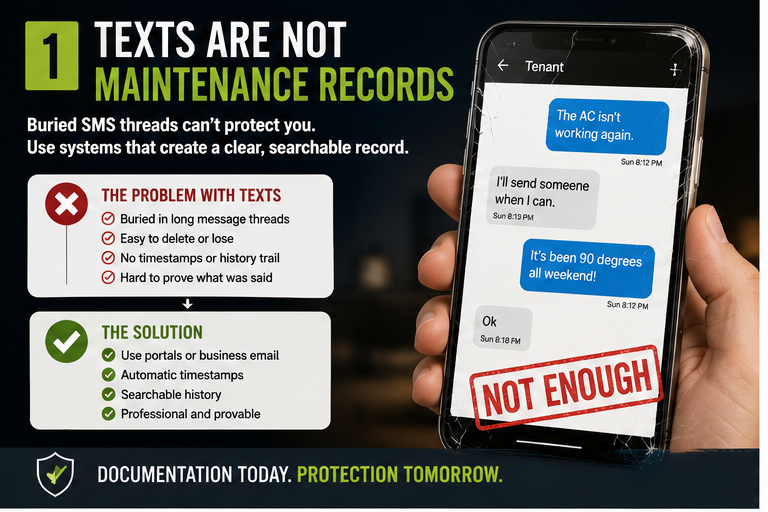
Most standard leases explicitly state that all notices must be in writing and delivered by specific methods, typically certified mail, hand delivery, or through a designated electronic portal. A text message rarely satisfies these contractual requirements. If a tenant texts you on a Friday night stating their air conditioning is broken, and you fail to respond until Monday, the tenant may attempt to claim you violated your statutory duty to repair under Section 92.052. However, if the lease requires maintenance requests to be submitted via a portal or formal email, the tenant’s text message may not constitute “proper notice” under the law.
Conversely, if you attempt to issue a formal warning about an unauthorized pet via text message, a Justice of the Peace will likely dismiss your enforcement action entirely. You cannot enforce the lease if you are simultaneously violating its notice provisions.
The Risk of Inadvertent Waivers
The casual nature of text messaging encourages informal language, which is dangerous in a legal context. Landlords frequently create inadvertent waivers of their rights simply by trying to be polite.
Consider a scenario where a tenant texts on the third of the month to say they will be a few days late with the rent. The landlord, busy at the grocery store, quickly replies with “No problem, just get it to me when you can.”
That single, casual sentence can be construed by a court as a formal modification of the lease agreement and a waiver of the right to collect late fees or file an eviction for that specific month. The landlord has unwittingly traded their legal leverage for a moment of convenience. A formal filing system forces a landlord to slow down, review the lease, and respond with precise, legally sound language.
The Nightmare of Document Production
When a dispute escalates to litigation, the court will require a complete record of communication. If your communication history exists entirely in an endless text thread, producing that record is a logistical nightmare.
You must screenshot hundreds of messages, attempt to organize them chronologically, and ensure no critical context is missing. Furthermore, text messages lack clear subject lines, making it nearly impossible to isolate a conversation about a specific plumbing repair from a conversation about a parking dispute that occurred in the same week.
If your phone is lost, damaged, or automatically deletes old messages to save storage space, your entire legal defense vanishes instantly. You cannot submit a broken iPhone as evidence in a Justice of the Peace court.

Establishing a Defensible System
The solution is not necessarily to ban text messaging entirely, but to restrict its use exclusively to logistical coordination and immediate emergencies. A text message is perfectly appropriate for telling a tenant the plumber will arrive in fifteen minutes, or warning them that the city is shutting off the water main for an hour. However, it is entirely inappropriate and legally reckless for discussing rent payments, negotiating lease terms, documenting lease violations, or accepting official maintenance requests.
You must actively train your tenants from the very first day of the lease to use your formal communication channels. If a tenant texts a maintenance request about a dripping sink, your response should be a polite but firm redirection. You must instruct them to submit the request through the official property management portal or via your designated business email address, explicitly stating that a formal written record is required before you can dispatch a vendor. Consistency is the key to enforcing this boundary.
By forcing communication into a centralized, searchable, and permanent filing system, you protect your legal standing. You transform your communication from a scattered liability into an organized, impenetrable defense.