In the business of real estate investing, fear of vacancy can be the enemy of yield. Too many property owners leave money on the table during the Houston summer because they are afraid of pushing a tenant out. They offer flat renewals or nominal $25 increases without checking whether current demand supports more. The opportunity is real, but it must be measured one neighborhood at a time.
Welcome back to Investor Corner. This month, we are analyzing the mechanics of the summer rent increase. We are moving past the emotional anxiety of turnover and focusing on the mathematical reality of market peaks. For landlords in Greater Houston, summer is the time to test your assumptions and capture the return your property can actually support.
The Velocity of Summer Demand
To price correctly, you must first understand the underlying market mechanics. Greater Houston summer leasing is shaped by school calendars, job changes, and the commute a tenant is willing to make. A house in Katy may compete for a different pool of applicants than a rental in Pearland or The Woodlands.
Families are looking to secure housing before the new school year begins. People relocating for work also weigh access to employment centers such as the Energy Corridor, Texas Medical Center, and downtown Houston. These overlapping moves can create competition for well-priced homes, but they do not guarantee multiple applications for every listing.
When demand outpaces supply, pricing power shifts to the landlord. If you are pricing a house in July based on comparables from February, you may be missing the market. Use recent leases and current competition in the same area. A Greater Houston average does not automatically describe conditions in Cypress, Sugar Land, or League City.
The Turnover Cost Calculation
The most common justification for below-market renewals is the cost of turnover. Landlords calculate the cost of painting, cleaning, and a potential two-week vacancy, and conclude that it is cheaper to keep the current tenant at a discount.
That calculation is incomplete unless you also measure the income you give up by renewing below market.
Consider a hypothetical Houston property currently renting for $1,800 a month, where comparable leased homes support a summer rate of $2,100. The landlord offers a “safe” renewal at $1,850. The tenant accepts, and the landlord avoids an estimated $1,500 in total turnover and vacancy costs.
By accepting $1,850 instead of $2,100, the landlord gives up $250 a month, or $3,000 over a fully occupied year. If the $1,500 estimate includes all costs of securing the new tenant, the higher rent takes six months to recover that expense. A longer vacancy, additional repairs, or a leasing fee changes the calculation.
The point is to compare complete scenarios. A rent increase can strengthen Net Operating Income (NOI), but it does not automatically produce a fixed increase in a single-family home’s resale value. During the summer peak, weigh the additional income against the actual cost and probability of turnover in your neighborhood.
Executing the Market Rate Renewal
When approaching a summer lease expiration, your opening position should be the current, data-backed market rate, adjusted for the value of retaining a dependable tenant.
Do not apologize for a well-supported increase, but explain it clearly. Begin the renewal conversation about 90 days in advance and follow the notice requirements in the lease. If the proposed increase is substantial, for example $200 a month, present the data. Show comparable homes with similar size, condition, school assignment, and commute access. In Greater Houston, a shared ZIP code alone does not make two houses comparable.
If they push back, you have a decision to make based on their record as a tenant. If they pay reliably and take care of the house, you might offer a slight concession, perhaps settling at $150 above their current rate instead of $200. You retain a great tenant while still capturing a meaningful income increase.

Pricing the Vacancy
If the tenant chooses to vacate, price the new listing deliberately. The summer market can move fast, but a house in Spring should be measured against its own competition, not a higher-priced rental across the metro. Do not list at the price you hope to get; list at the price the data supports.
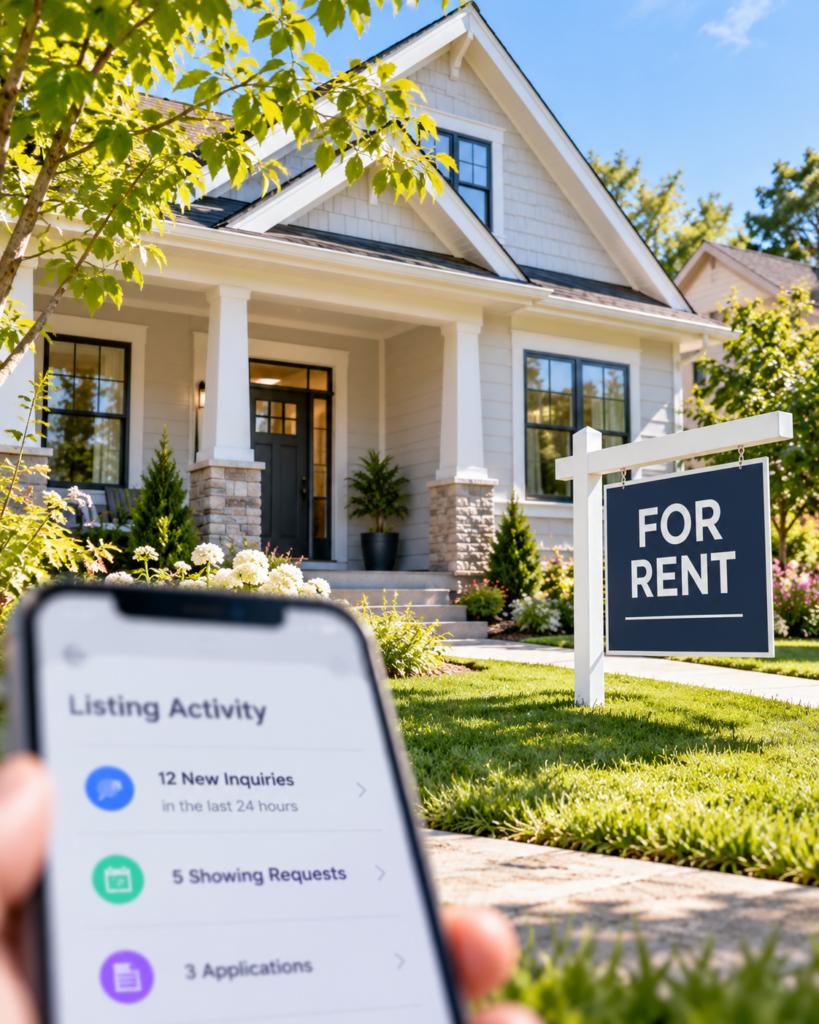
Monitor the listing daily. If nearby comparable homes are generating activity and yours receives few inquiries or no applications after a week, investigate immediately. Review the price, photos, showing access, and property condition. Adjust the rent when the evidence calls for it rather than applying an automatic percentage reduction.
The goal is to capture summer demand at the strongest achievable rent while minimizing days on market. By replacing fear with a complete calculation, you position your Greater Houston rental to produce more income without turning a reasonable renewal into an expensive vacancy.