This Content Is Only For Subscribers
In property management, the strength of a lease-violation case often depends less on how certain the landlord feels and more on what the landlord can prove. If a dispute involving a Greater Houston rental reaches a Justice of the Peace court, or if it develops into a Fair Housing complaint, a clear written record will carry far more weight than memory or informal conversations.
Welcome back to Landlord Legal Lowdown. This month, we conclude our series on summer lease compliance by examining the role of documentation in enforcing lease violations for Greater Houston landlords. Unauthorized occupants, pets, repeated noise complaints, parking problems, property damage, and issues that surface after storm or repair work are easier to manage when the landlord follows the same objective process every time.

The Legal Standard of Evidence
When a landlord seeks possession based on a lease violation rather than nonpayment of rent, the landlord should be prepared to prove the underlying facts and connect them to the lease provision being enforced. In an eviction case, the court will look at the evidence presented, the lease language, the notices given, and whether any required procedures were followed.
Objective evidence makes the file stronger. If a landlord alleges an unauthorized pet, a single verbal complaint may be difficult to evaluate. A date-stamped photograph, a written resident complaint, inspection notes made at the time of the event, and a copy of any formal notice to the tenant create a much clearer record. The same approach applies to recurring noise, unauthorized occupants, parking problems, or damage at a Greater Houston rental property.
The Notice of Lease Violation
A written Notice of Lease Violation is often the foundation of a consistent enforcement process. Whether a cure notice is legally required depends on the lease and the circumstances, but a formal written notice can establish what the landlord observed, what lease term is involved, what the tenant is expected to do, and what may happen if the problem continues.
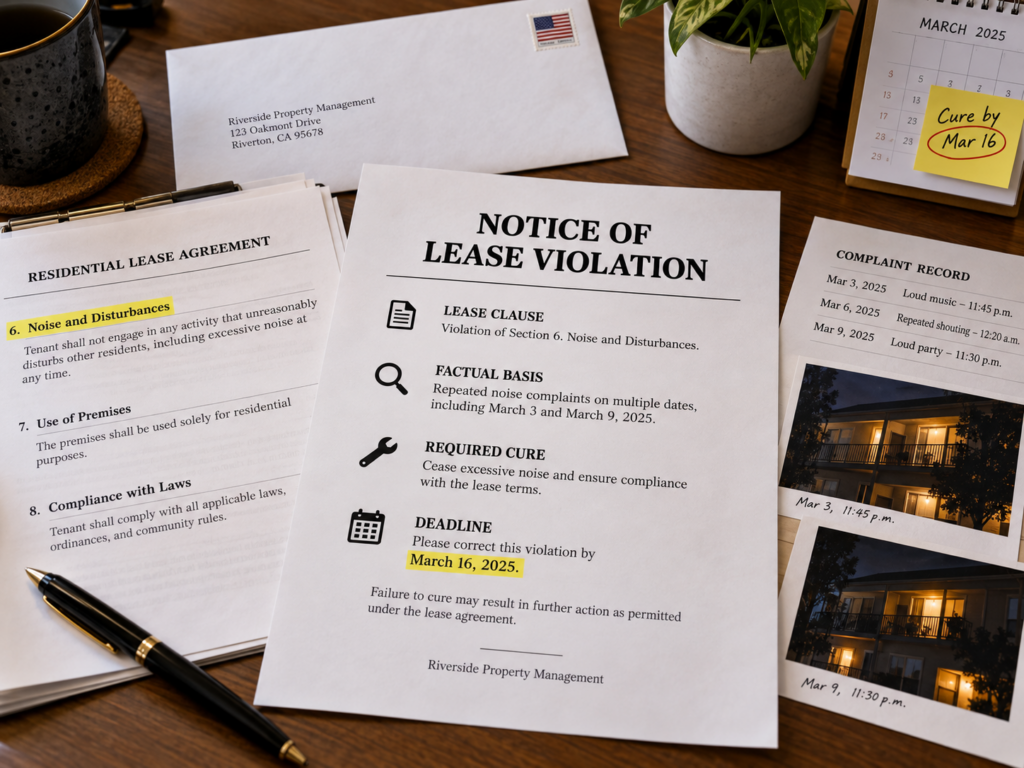
A strong Notice of Lease Violation should contain four practical elements:
1. The Specific Clause: Identify the lease provision or rule that the landlord believes has been violated.
2. The Factual Basis: Describe the conduct objectively, including relevant dates, times, locations, photographs, complaints, or inspection findings.
3. The Required Cure: If the tenant is being given an opportunity to cure, state exactly what must change, such as removing an unauthorized vehicle or stopping repeated prohibited conduct.
4. The Deadline and Consequence: If a deadline applies, state it clearly and explain the potential consequence of continued noncompliance, which may include additional enforcement or a Notice to Vacate when permitted by the lease and Texas law.
The Danger of Informal Communication
A common mistake among independent landlords is trying to manage repeated violations entirely through casual texts or phone calls. Informal communication can be useful for routine problem solving, but it should not replace a formal notice when the lease or law requires one.
Text messages and emails may still become evidence, so landlords should write them as though they may later be read by a judge or investigator. The problem is not that electronic communication is automatically useless. The problem is relying on a vague message with no clear facts, deadline, or connection to the lease and then expecting it to carry the same weight as a well-documented formal notice.
Informal statements can also complicate later enforcement. A message such as, ‘Don’t worry about the late fee this month,’ may be raised later as evidence of a waiver or modification. For Greater Houston landlords, the safer practice is to keep routine communication professional and place actual enforcement decisions in a consistent written process that follows the lease.
The Imperative of Consistency
Documentation is also important for Fair Housing compliance. Federal law prohibits discrimination based on protected characteristics, and inconsistent enforcement can create serious questions about why similar tenants were treated differently. A landlord should be able to explain each enforcement decision with neutral facts and the same lease standards used across the portfolio.
For example, if one tenant receives a formal notice after repeated, documented noise complaints while another tenant receives no response to similar verified conduct, the inconsistency may undermine the landlord’s credibility and can create unnecessary Fair Housing risk. The goal is not to punish every tenant identically regardless of circumstances, but to use objective criteria and document legitimate reasons for different treatment.
A standardized process makes that easier. When each violation is logged, supported with available evidence, matched to the lease, communicated in writing, and followed up on consistently, the landlord creates a record that is much easier to explain in the appropriate local Justice Court or any later administrative review.
Conclusion: The Record is the Reality
In the legal arena, documentation turns a landlord’s version of events into a record that can actually be evaluated. For Greater Houston landlords, consistent notes, photographs, notices, and follow-up records can mean the difference between a manageable lease issue and a dispute that becomes difficult to prove.